

Localized Constructed Analogues (LOCA) is a widely used downscaling approach developed by Pierce and Cayan to translate the coarse-scale model results to the fine-scale. LOCA, and the updated version LOCA2, looks at model projections and uses observed historical patterns of the relationship between the coarse and fine-scale to develop fine-scale model projections for the future. Pierce and Cayan are beginning to downscale sample CMIP6 historical simulation data using LOCA2 and will be working with Longmate and Risser to validate these results.
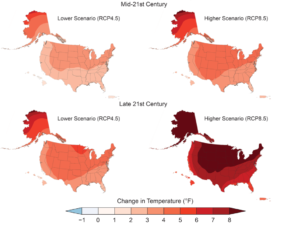
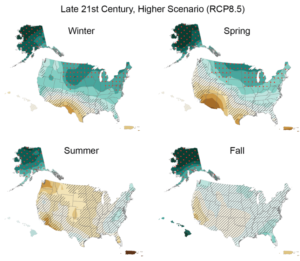
From the last CMIP phase (CMIP5), LOCA was trained on data through 2005, but a number of extreme events have occurred since then. We test, through observations, whether and in what regions LOCA trained on data through 2005 differs significantly from LOCA trained on data through 2015. We will determine the “shelf-life” of nonstationarity in statistical downscaling using these observations.
We test how and where statistical and dynamical downscaling solutions may diverge under more severe climate change, using simulations that have already been completed as part of the DOE FACETS project as a basis for an intercomparison of downscaling solutions.
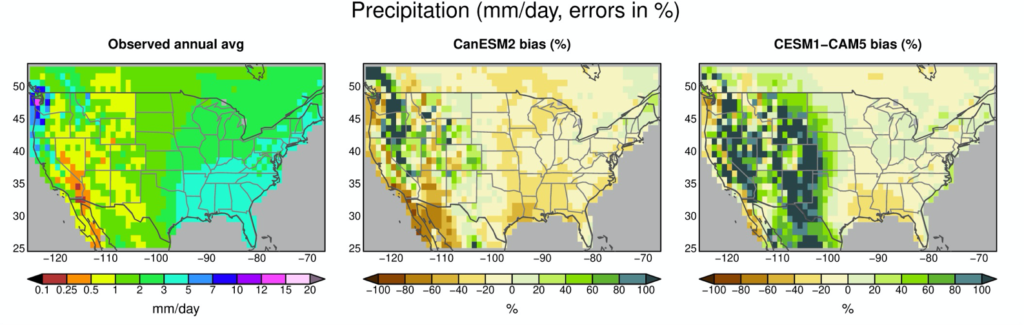
Building off of the work of Alex Hall, we analyze downscaling solutions to understand which, if any, CMIP6 models capture the underlying physical processes that lead to important nonstationarity effects at the local level in temperature and precipitation over the CONUS.
We will develop metrics based on processes which we expect to produce fundamental changes in spatially-varying weather patterns.
We will develop a single set of projections of temperature and precipitation and associated uncertainties for different emissions scenarios across the CONUS by weighting or down-selecting CMIP6 models based on their process-based skill metric performance. Where CMIP6 models fail, further investigation into dynamical downscaling solutions will be needed.
The objective of our research is to develop a process-based evaluation of the large number of climate model simulations from the Coupled Model Intercomparison Project —Phase 6 (CMIP6) in order to develop robust estimates of changes, and associated confidence intervals, in temperature and precipitation distributions across the Conterminous United States (CONUS).
We are currently exploring how to prioritize the downscaling of CMIP6 given the large number of models and ensemble members and finite computational and human resources for downscaling. The work so far finds that ensemble members of a given model are substantially similar, so downscaling should generally focus on different models, rather than different ensemble members.
Feldman and Risser are in the process of preparing a manuscript on a fundamental issue in evaluating historical model performance: historical station data are point measurements while models report grid-box averages. This is particularly problematic for precipitation, since it is a fractal field and can lead to apparent problems with historical model simulations, and by extension confidence in future projections, that are solely the result of this apples-to-oranges comparison. We are evaluating where in the CONUS this issue is most severe.
Pierce, Cayan, and Risser report on a significant data reporting issue from historical weather stations which sometimes categorized the first morning observation as originating from the previous day. This led to an underreporting of daily extreme precipitation by 33%.